Save $10 On Your First Install. Use Code BLOG10
-min.webp)

Auxe is operating as an essential business
Save $10 On Your First Install. Use Code BLOG10
Security problems do not stop when the sun goes down. In fact, many break-ins, thefts, trespassing incidents, and suspicious activities happen at night because visibility is low and fewer people are around. That is why night vision CCTV cameras are no longer just an extra feature. For many homes, offices, warehouses, parking lots, retail stores, and commercial properties, they are a basic security requirement.
By
Auxe
|
July 15, 2026


.png)

.jpg)
.png)
Security problems do not stop when the sun goes down. In fact, many break-ins, thefts, trespassing incidents, and suspicious activities happen at night because visibility is low and fewer people are around. That is why night vision CCTV cameras are no longer just an extra feature. For many homes, offices, warehouses, parking lots, retail stores, and commercial properties, they are a basic security requirement.

Security problems do not stop when the sun goes down. In fact, many break-ins, thefts, trespassing incidents, and suspicious activities happen at night because visibility is low and fewer people are around. That is why night vision CCTV cameras are no longer just an extra feature. For many homes, offices, warehouses, parking lots, retail stores, and commercial properties, they are a basic security requirement.
But buying a night vision CCTV camera is not as simple as picking the camera with the highest resolution or the longest night vision range. Many people make that mistake. They buy a camera that looks powerful on paper, but the footage is blurry, faces are unclear, license plates are unreadable, or the camera performs poorly in Canadian weather.
This guide explains what you need to know before buying night vision CCTV cameras, how they work, which features matter, and how to choose the right system for your property.
AI-powered CCTV cameras are security cameras that use artificial intelligence, machine learning, or video analytics to understand what is happening in a scene. Instead of treating every movement the same, they can classify activity more intelligently.
For example, a basic camera may send an alert every time a tree moves, a shadow changes, or a cat walks across the driveway. An AI camera can be configured to focus on important events, such as a person entering a restricted area or a vehicle stopping where it should not be.
Modern AI video analytics can detect, classify, track, and count humans and vehicles. Some systems can also support more advanced features, such as vehicle type detection, occupancy tracking, perimeter protection, license plate recognition, and object detection.
In simple words, AI CCTV helps turn normal video footage into useful security information.
AI CCTV cameras use software algorithms to analyze video. The system looks at objects, movement, shapes, patterns, and scene behavior. Based on the camera model and software, it can decide whether an event is important enough to record, alert, count, or flag for review.
Some AI cameras process video directly inside the camera. This is called edge analytics. Edge-based analysis can reduce bandwidth use because the camera does not need to send every piece of video to a server for analysis. Axis notes that edge-based analytics processes live video directly on compatible cameras, which can reduce the need for separate servers. Other systems process video through an NVR, cloud platform, or separate AI appliance. These setups may be better for larger sites, multiple cam eras, or more advanced analytics. The best option depends on the property size , camera count, storage needs,internet quality, privacy concerns, and budget.

This is one of the most useful AI CCTV security camera features. The camera can tell the difference between a person, vehicle, and general motion. This matters because traditional motion detection is dumb. It often reacts to rain, insects, headlights, shadows, leaves, and animals. AI-based person and vehicle detection helps reduce useless alerts and keeps attention on real security events.
For a home, this can mean getting alerts when someone enters the driveway or approaches the front door. For a business, it can mean detecting people after closing time or vehicles entering are stricted area.
Basic motion detection only knows that something moved. Smart motion detection tries to understand what moved and whether it matters. For example, if a person walks across a park lot at 2:00 AM, that may be important. If a branch moves in the wind, it is probably not. This is where AI adds real value. The goal is not just more alerts. The goal is better alerts.
Line crossing detection allows you to create a virtual line in the camera view. If a person or vehicle crosses that line, the system can trigger an alert or recording. This is useful for driveways, gates, loading docks, warehouses, office entrances, parking lots, school zones, and restricted business areas. For example, a business can set a virtual line near a back entrance. If someone crosses that line after business hours, the system sends an alert.
Intrusion detection is used to monitor specific zones. You can mark an area in the camera view, and the system alerts you when a person or vehicle enters that zone. This is useful for places where nobody should be after hours, such as storage rooms, construction sites, rooftops, warehouse yards, fenced areas, or private parking sections. AI makes intrusion detection more useful because the system can focus on humans or vehicles instead of reacting to every random movement.
Loitering detection identifies when a person stays in one area longer than expected. This can be useful for storefronts, ATMs, parking lots, apartment entrances, office buildings, gas stations, and commercial properties. Someone standing near a door for a few seconds may be normal. Someone staying there for ten minutes late at night may need attention. This feature is not perfect, but when configured properly, it can help security teams notice suspicious behavior earlier.
AI CCTV systems feature can help identify known individuals from a watchlistor authorized database. However, this is where businesses need to be careful. Facial recognition is sensitive technology. It can create serious privacy, legal, and trust issues if used carelessly. For most small businesses, facial recognition is not the first feature to prioritize. Person detection, vehicle detection, smart alerts, and good camera placement usually matter more. If facial recognition is needed, it should be used with clear policies, proper consent where required, limited access, and profesessional legal guidance.
In Canada, private sector video surveillance must b e balan ced against individuals’ priv acy rights, and organizations are expected to limit camera use, give notice, secure recordings, and use video only for legitimate business reasons.
License Plate Recognition, also called LPR, is used to capture and identify vehicle plates. It can help with par king lots, gated communities, commercial yards, logistics areas, office buildings, and high-security sites. But LPR needs the right setup. A normal camera pointed at a road may not capture plates clearly. You need the correct angle, shutter settings, lighting, distance, and camera placement. At night, headlights and reflections can make plate capture difficult.
If license plates matter, do not rely on a random camera. Use a proper LPR-compatible setup.
Object detection can help identify items that are left behind, removed, or placed in aspecific area. For example, it may help detect an unattended package, equipment movement, or an object removed from a monitored zone. Advanced video analytics platforms include object detection features for proactive security response.
This feature can be useful in office , warehouses, retail stores , schools, hospitals, and public-facing commercial spaces.
AI CCTV cameras are not only for security. They can also support business operations. People counting helps businesses understand foot traffic, peak hours, customer flow, and occupan c y levels. This is useful for retail stores, restaurants, gyms, clinics, offices, shopping areas, and even spaces.
For example, a store can use people counting data to understand when it needs more staff. A building manager can monitor occupancy levels for safety and planning. Axis lists people and vehicle counting as part of AI-powered analytics for operational insights.
This is where AI CCTV becomes more than a security tool. It becomes a business intelligence tool.
One of the biggest benefits of AI CCTV is real-time alerting .
Instead of discovering an incident hours later, the system can notify you when something happens. Alerts can b e sent to a mobile app, monitoring center, security team,or video management system. This helps reduce response time. For a homeowner, that may mean knowing when someone enters the backyard. For a business, it may mean alerting staff when someone enters a restricted area after closing.
Real time alerts are useful only when they are accurate. Too many false alerts cause people to ignore them. That is why proper configuration is critical.
Searching old footage manually is painful. AI can make this process much faster. Instead of watching hours of video, some systems allow you to search by person, vehicle, time, area, or event type. Avigilon describes AI analytics as useful for automating investigations and red uci ng investigation time through quick search tools.
This is valuable after theft, vandalism , trespassing, workplace incidents, customer disputes, delivery issues, or parking lot problems. For businesses, faster footage search saves time. For security teams, it helps them respond with better information.
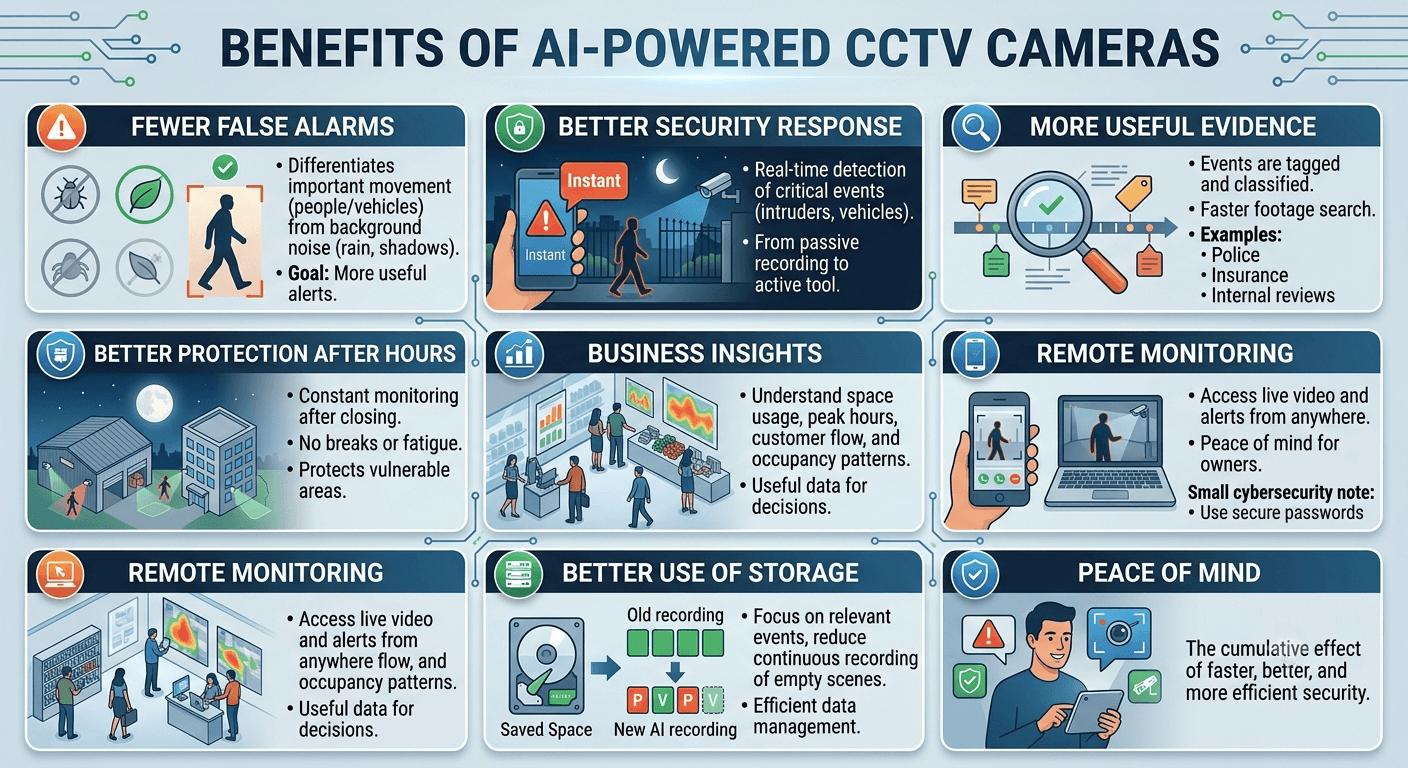
False alarms are one of the biggest problems with traditional CCTV systems. A basic motion ca mera may alert you because of rain, bugs, shadows, headlights, moving branches, or animals. AI helps reduce this problem by identifying whether the movement is actually important. For example, the camera can focus on people and vehicles instead of every small movement.
This does not mean false alarms disappear completely. Anyone who says AI eliminates all false alarms is selling fantasy. But a properly installed AI system can reduce unnecessary alerts and make the security system more useful.
AI C CTV helps you react faster because it can detect important events in real time. For example , if a person enters a warehouse yard at night, the system can send an alert immediately . If a vehicle enters a restricted parking area, the system can flag the event. If someone loiters near an entrance, the system can notify security.
This turns CCTV from a passive recording to roll into an active security tool.
A security camera is only useful if the footage is clear and easy to find. AI helps by tagging events, classifying activity, and making footage easier to search. Instead of scrolling through hours of video, you can find the relevant clip fast.
This can help with police reports, insurance claims, internal investigations, property disputes, theft cases, and workplace saf ety reviews.
Many security incidents happen when nobody is watching. AI CCTV is especially useful after closing time. A retail store can monitor entrances and cash areas. A warehouse can monitor loading docks and storage zones. An office can monitor restricted rooms. A homeowner can monitor the driveway, backyard, and garage.
The camera does not get tired. It does not need breaks. It keeps checking the scene based on the rules you set.
AI CCTV can also help businesses understand how people use a space. Retail stores can track busy hours. Offices can understand occupancy patterns. Restaurants can study customer flow. Property managers can monitor parking areas and entrances. Warehouses can improve safety by monitoring movement in risky zones.
This does not replace good management, but it gives useful data. Better data usually leads to better decisions.
Most modern AI CCTV systems support mobile or remote access. This means you can receive alerts, view live footage, and review events from your phone or computer. For business owners, this is a major benefit. You do not need to be physically present t o know what is happening. For home owners, it adds peace of mind when traveling or away from home. Remote access should be secured properly. We ak passwords, shared logins, and outdated firmware are security risks. A smart camera with poor cybersecurity is not smart. It is a liability.
AI can help reduce unnecessary recording by focusing on relevant events. Instead of recording every small motion, the system can record based on people, vehicles, zones, or specific triggers. This can save storage space and make footage review easier.
However, some properties still need continuous recording. For businesses, the best setup often combines continuous recording with AI event tagging. That way, you keep full footage while still making important events easy to find.
AI-powered CCTV cameras are useful in many places, including homes, offices, retail stores, warehouses, restaurants, clinics, apartment buildings, parking lots, schools, construction site s, and commercial properties. For homes, the most useful features are person detection, vehicle detection, smart alerts , night vision, and mobile access.
For businesses, the most useful features are intrusion detection, line crossing, loitering detection, people counting, license plate recognition, remote access, and fast footage search.For warehouses and industrial sites, AI cameras can help monitor restricted areas, loading docks, safety zones, vehicle movement , and a fter-hours access.
For retail stores, AI cameras can help reduce theft, monitor customer flow, review incidents, and improve staffing decisions.
Traditional CCTV records what happens. AI CCTV helps understand what happens.
That is the main difference.
A traditional camera may show you video after the incident. An AI camera may alert you while the incident is happening.
A traditional camera may record hours of empty footage. An AI camera can tag important moments.
A traditional motion camera may alert you constantly. An AI camera can reduce noise by focusing on humans, vehicles, or defined behaviors.
Traditional CCTV still has value. But for modern security, AI features are becoming harder to ignore.
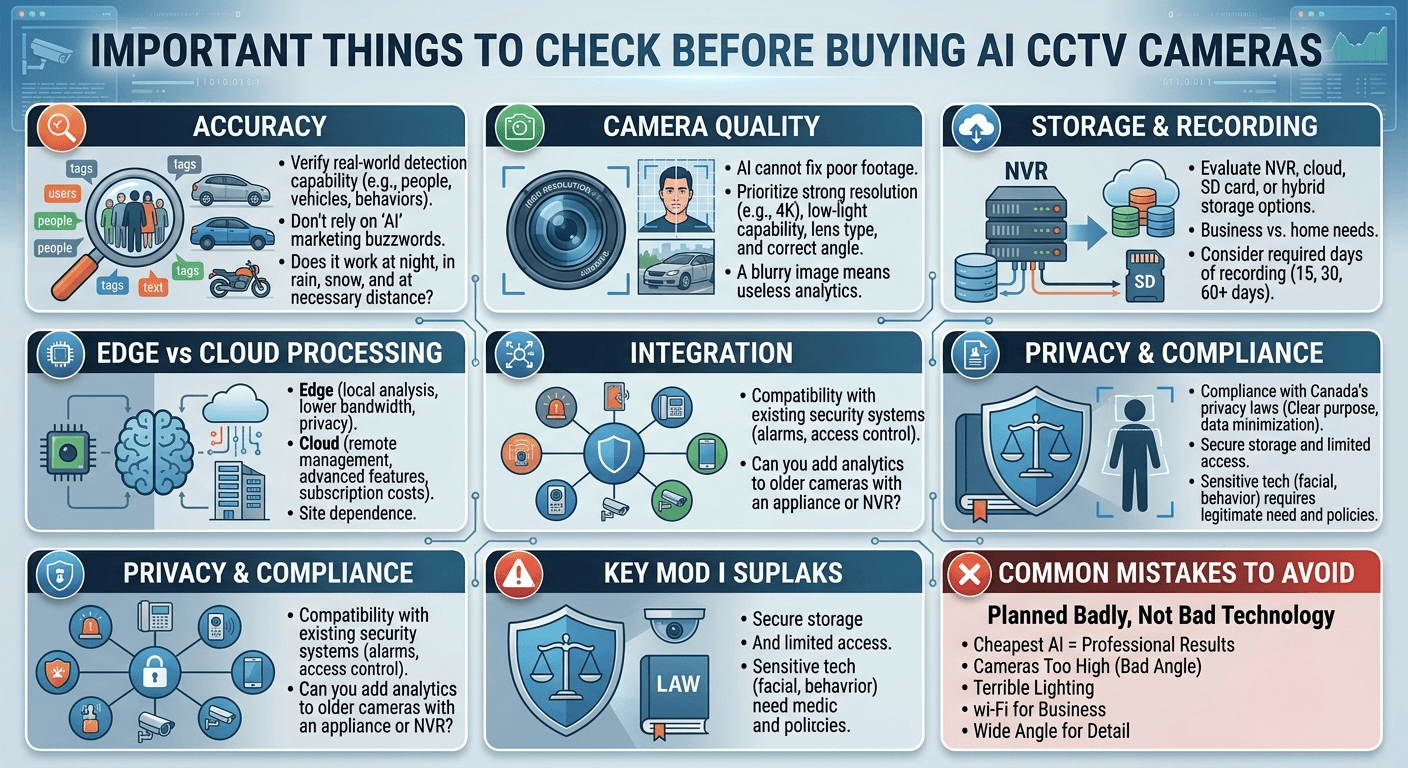
Do not buy based only on the word “AI.” Many cheap cameras use the term loosely. Some only have basic motion detection with fancy marketing.
Check what the camera can actually detect. Can it detect people? Vehicles? Line crossing? Loitering? License plates? Occupancy? Does it work at night? Does it work in rain or snow? Does it work at the distance you need?
Marketing claims are easy. Real performance is what matters.
AI cannot fix bad footage. If the image is blurry, dark, overexposed, or poorly angled, the analytics will suffer. A good AI CCT V cam era still needs strong resolution, good night vision, proper lens selection, weather resistance, and correct installation.
Check whether the system uses an NVR, cloud storage, SD card, or hybrid setup.For homes, cloud or NVR storage may be enough. For businesses, an NVR or professional video management system is usually better.
Also check how many days of recording you need. A small home may only need a few days. A business may need 15, 30, 60, or more days depending on operations and policy.
Edge processing means the camera analyzes video locally. Cloud processing means footage or data is sent to a cloud platform for analysis. Edge processing can reduce bandwidth and may improve privacy because less d ata n eeds to leave the si t e. Cloud processing can offer advanced features and easier rem ote management, but it depends heavily on interne t quality and subscription costs.
Neither option is a utomatically better.
The right choice depends on your site.
A good AI CCTV system should work with your security setup. This may include alarms, access control, intercoms, mobile apps, monitoring services, or video management software. If you already have cameras, you may not need to replace everything. Some systems can add analytics through an NVR, server, or AI appliance. Avigilon notes that AI analytics can be integrated with video security, alarms, access control, and other commercial security systems.
This part is not optional.
If you are using CCTV in Canada, especially for a business, you need to think about privacy. Cameras should have a clear purpose. They should not record more than necessary. Footage should be stored securely. Access should be limited. People should be informed that surveillance is taking place. AI features make privacy even more important. Facial recognition, license plate recognition, and behavior analytics can collect sensitive information. Use these features only when there is a legitimate need and proper policy in place.
Do not buy the cheapest “AI camera” and expect professional results.
Do not install cameras too high and expect clear face identification.
Do not rely on AI if the lighting is terrible.
Do not use facial recognition without understanding privacy risks.
Do not ignore cybersecurity.
Do not assume Wi-Fi cameras are reliable enough for serious business security.
Do not use one wide-angle camera to cover a large area and expect detailed identification.
Most CCTV failures are not because the technology is bad. They happen because the system was planned badly.
Yes, AI-powered CCTV cameras are worth it when you need smarter alerts, faster footage search, better after-hours monitoring, and fewer false alarms. For homes, AI cameras can make daily security easier and more practical. For businesses, they can improve safety, reduce manual review time, and provide useful operational insights .
But AI CCTV is not automatically worth it if you only need basic recording in a low-risk area. In that case, a standard CCTV system may be enough. The honest answer is simple: AI is valuable when the features match the real security problem.
AI-powered CCTV cameras are changing how homes and businesses handle security. They do not just record foot age. They help detect people, vehicles, suspicious activity, restricted-area access, loitering, and other important events . The biggest benefits are faster alerts, fewer false alarms, easier footage search, better after-hours protection, and useful business insights. But the system must be chosen carefully. The camera quality, installation angle, lighting, storage, privacy policy, and configuration all matter.
Do not buy AI CCTV just because it sounds advanced. Buy it because it solves a real problem on your property.
At Auxe, we help homeown ers and businesses choose CCTV systems that fit their actual needs. Whether you need AI-powered cameras for a home, office, retail store, warehouse, parking lot, or commercial property, the right setup can give you smar ter security and better control day and night.


.webp)
Our online price calculator is free and requires no credit card, email, or contact information. Check it out!
Our online price calculator is free and requires no credit card, email, or contact information. Check it out!

%20(1).png)
.png)
.png)
.png)
.png)
.png)
.png)
.png)
.png)
.png)
.png)
.png)
.png)
%20(1).png)
%20(1).png)
%20(1).png)
.png)



.webp)


.webp)
%20(1).webp)