Save $10 On Your First Install. Use Code BLOG10
-min.webp)

Auxe is operating as an essential business
Save $10 On Your First Install. Use Code BLOG10
DIY is a great "entry-level" hobbyist solution, Professional CCTV Installation remains the gold standard for serious security systems. Hiring a professional installer like Auxe would be the best option for CCTV installation.
By
Ali
|
April 17, 2026


.png)

.jpg)

DIY is a great "entry-level" hobbyist solution, Professional CCTV Installation remains the gold standard for serious security systems. Hiring a professional installer like Auxe would be the best option for CCTV installation.
When it comes to securing your home or business in Canada, the "How" is just as important as the "What." In 2026, the market is flooded with high-tech security gadgets that promise "plug-and-play" safety. On one side, you have the DIY (Do-It-Yourself) movement—convenient, affordable, and accessible. On the other, you have professional CCTV installation—a comprehensive, engineered approach to security.
Choosing between the two isn't just about saving a few dollars; it’s about understanding the specific challenges of the Canadian environment, privacy laws, and technical infrastructure. This guide provides an in-depth analysis to help you decide which path is right for your property.
The most immediate difference between DIY and a professional installation is the price. However, looking only at the initial receipt is a mistake many Canadian property owners regret later.
A standard DIY kit from a big-box retailer or online marketplace usually costs between $300 and $700. These kits often include 2 to 4 wireless cameras and a basic hub. Since you are doing the labor, you save on installation fees.
The Hidden Costs of DIY:
Professional installation for a residential property typically starts at $1,200 to $2,500, depending on the number of cameras and the complexity of the wiring. This includes the hardware, the labor, and the configuration.
The Long-Term Value:
Canada presents a unique engineering challenge for electronics. A camera that works perfectly in California will likely fail during a polar vortex in Saskatoon or a damp winter in Vancouver.
Most DIY cameras are battery-powered for ease of installation. However, lithium-ion batteries are chemically incapable of holding a charge when temperatures drop below -20°C. Even "cold-weather" batteries often struggle when the mercury hits -30°C, leading to "dead zones" in your security precisely when you might need it most.
Professional installers almost exclusively use PoE (Power over Ethernet). A single cable provides both the data connection and the electricity.
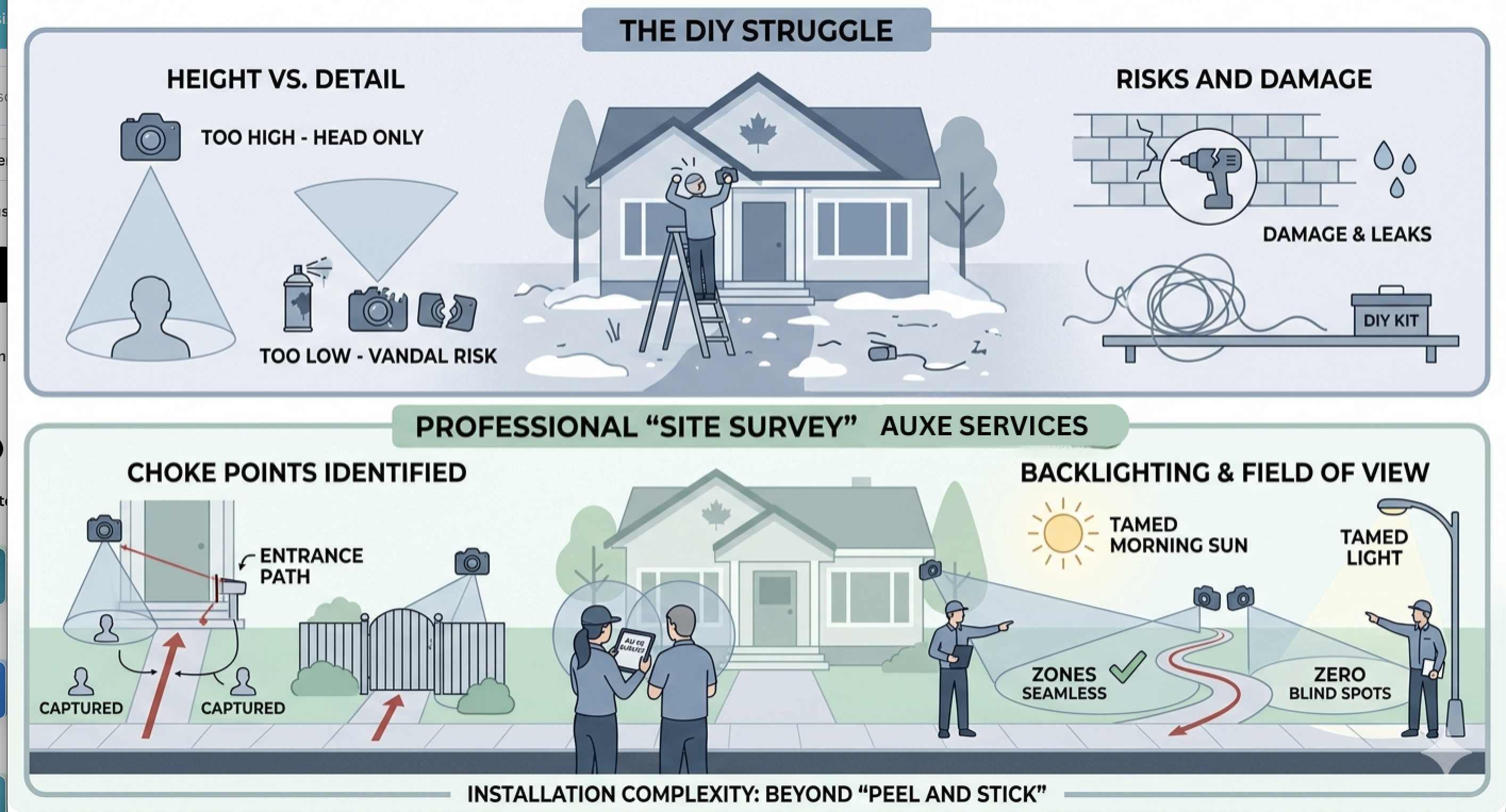
Installing a camera seems easy until you have to deal with the structure of a Canadian home.
DIYers often face the "Height vs. Detail" dilemma. If you mount a camera too low, it’s easy to vandalize. If you mount it too high (like on a second-story soffit), you only see the tops of people's heads. Without the right tools—like specialized drill bits for brick or stucco—you risk damaging your home’s exterior or creating a path for water leaks.
A professional doesn't just show up and start drilling. They perform a site survey to identify:
This is the most overlooked aspect of CCTV. In Canada, your right to protect your property is balanced against the privacy rights of the public and your neighbors.
If you are a business owner, you must comply with the Personal Information Protection and Electronic Documents Act (PIPEDA). This requires you to have a clear purpose for recording, a way for people to request access to their footage, and strict data retention policies.
DIYers often accidentally record too much. If your camera is pointed directly at a neighbor’s window or into their backyard, you could face a civil lawsuit or a visit from the police. Professional installers understand "Privacy Masking." They can program the software to digitally "black out" certain areas of the frame (like a neighbor's window) while still recording the rest of your driveway. They also ensure you have the legally required CCTV signage in place to satisfy local bylaws.
.png)
In 2026, cybersecurity is just as important as physical security.
Most DIY cameras connect directly to your home Wi-Fi. If your Wi-Fi password is weak or the camera’s firmware isn't updated, hackers can gain access to your live feed. Furthermore, if an intruder uses a Wi-Fi Jammer (a cheap device widely available online), your DIY cameras will stop recording entirely.
Professional systems are hardwired. They don't care if your Wi-Fi is jammed or if the router is reset.
A security system is not a "once and done" purchase. It requires ongoing maintenance to ensure it actually works when a crime occurs.
With a DIY system, you are the technician. You are responsible for:
Many professional installers offer Service Level Agreements (SLAs). For a small annual fee, they will come out once or twice a year to clean the cameras, check the wiring, update the software, and ensure the storage is recording correctly. If something goes wrong, you have a local human to call rather than a 1-800 number in a different time zone.
.png)
There is a massive difference between "4K" on a DIY box and "4K" on a professional camera.
DIY cameras often compress their video heavily to save on cloud storage costs and Wi-Fi bandwidth. This leads to "pixelation," where a person's face looks blurry when they move quickly. Professional cameras use high bitrates. They capture clear, fluid motion (30 frames per second or higher), which is crucial if you ever need to provide evidence to the police or an insurance company. You can zoom in on a license plate or a tattoo without the image falling apart.
The "better" choice depends entirely on your specific needs and the value of what you are protecting.
In the end, while DIY is a great "entry-level" hobbyist solution, Professional CCTV Installation remains the gold standard for serious security systems. Hiring a professional installer like Auxe would be the best option for CCTV installation. In the harsh and legally complex environment of Canada, having a system that is engineered for the weather, optimized for the law, and hardwired for reliability is an investment that pays for itself the first time a threat is deterred.


.webp)
Our online price calculator is free and requires no credit card, email, or contact information. Check it out!
Our online price calculator is free and requires no credit card, email, or contact information. Check it out!

%20(1).png)
%20(1).png)
.png)
.png)
.png)
.png)
.png)
.png)
.png)
.png)
.png)
.png)
.png)
.png)
.png)
%20(1).png)
%20(1).png)
%20(1).png)
.png)


.webp)


.webp)
%20(1).webp)